Franchise vs. Independent Business: The Real Numbers
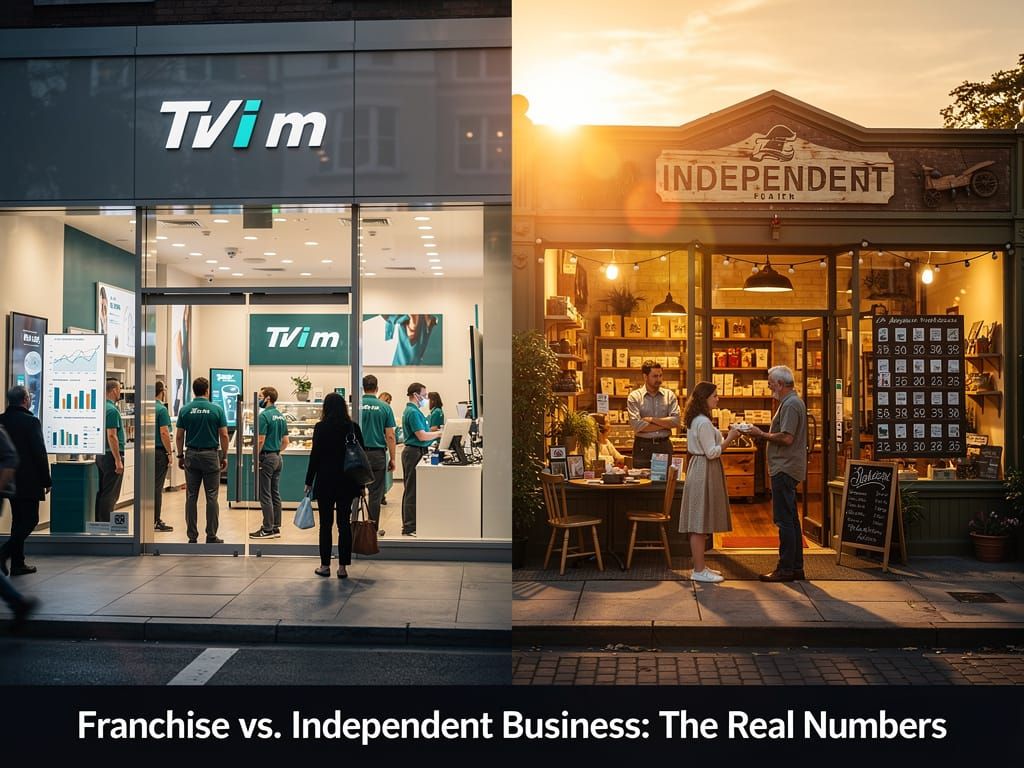
Every year, tens of thousands of Americans face the same fork in the road: buy into a proven franchise system or build something from scratch. Both paths can generate serious wealth. Both can also destroy your capital just as efficiently. The difference between a smart decision and a costly one comes down to understanding the actual numbers behind each model - not the marketing pitch, not the success stories, but the raw financial mechanics.
The franchise industry in the United States generates over $800 billion annually and employs roughly 8.4 million people across more than 790,000 franchise establishments. Those are impressive headline figures. But aggregate industry success tells you nothing about what your specific unit economics will look like three years after you sign the franchise agreement. That requires a different kind of analysis entirely.
Independent businesses, on the other hand, carry a reputation for high failure rates that is partly deserved and partly misunderstood. The often-cited statistic that 90% of small businesses fail within the first year is simply false. According to Bureau of Labor Statistics data, approximately 20% of new businesses fail in year one, and around 45% close within five years. That is a real risk profile - but it is a manageable one when you approach it with capital discipline and market research.
Here is the truth: neither model is inherently superior. What matters is which model fits your specific financial position, risk tolerance, and operational skill set. Let us break down the numbers side by side so you can make a genuinely informed decision.
The Upfront Capital Requirement
This is where most people get their first real shock. Franchise entry costs are not just the franchise fee - they are the total initial investment, which includes real estate, equipment, inventory, working capital, and the fee itself.
- Franchise fee: The upfront licensing fee paid directly to the franchisor typically ranges from $20,000 to $50,000 for mid-tier brands. Premium brands like McDonald's or Chick-fil-A can require fees and total investments exceeding $1 million to $2.5 million.
- Royalty obligations: Most franchise agreements require ongoing royalty payments of 4% to 12% of gross revenue - not net profit. This is a critical distinction. You pay royalties whether you are profitable or not.
- Marketing fund contributions: On top of royalties, franchisees typically contribute an additional 1% to 4% of gross revenue to a national or regional marketing fund they do not control.
- Independent business startup costs: A comparable independent business in the same sector - say, a quick-service restaurant - might require $150,000 to $400,000 in total startup capital, with zero ongoing royalty obligations.
- Working capital runway: Both models require a working capital buffer. Industry standard is 6 to 12 months of operating expenses held in reserve. Undercapitalization is the single most common cause of early-stage business failure across both categories.
- SBA loan eligibility: Franchises from SBA-approved franchisors often qualify for SBA 7(a) loans more easily than independent startups, which can meaningfully reduce your equity requirement at launch.
Survival Rates and Revenue Benchmarks
The franchise industry frequently cites a 90% five-year survival rate for franchised units. Independent research paints a more nuanced picture. A study published in the Journal of Marketing Channels found that after controlling for industry type and location, franchise survival rates were not statistically superior to comparable independent businesses in the same sector.
- Average franchise unit revenue: Across all franchise categories, the median annual revenue per unit sits around $940,000 according to FRANdata. However, median owner earnings after royalties, fees, and debt service are considerably lower - often in the $50,000 to $100,000 range for single-unit operators.
- Independent business revenue ceiling: Without royalty obligations, a profitable independent business retains a larger share of every dollar earned. The trade-off is that building brand recognition and customer acquisition systems from zero requires time and marketing spend that franchisees effectively outsource to the parent brand.
- Break-even timelines: Franchise units in food service typically reach break-even between 18 and 36 months. Well-capitalized independent businesses in service industries can reach break-even faster - sometimes within 12 months - because of lower fixed overhead structures.
- Resale value dynamics: Established franchise units from recognized brands often carry stronger resale multiples because buyers are purchasing a proven system, not just a customer list. Independent businesses can command strong multiples too, but they require more rigorous documentation of systems and financials to justify the valuation.
Where the Real Decision Lives
After working through the numbers, the honest conclusion is this: a franchise is essentially a risk-reduction product that you pay a premium for. You are buying a playbook, a brand, and a support infrastructure. That premium - expressed through fees, royalties, and reduced operational autonomy - is the price of a lower variance outcome. For first-time business owners with limited operational experience, that trade-off can be entirely rational.
An independent business, built with genuine market research and adequate capitalization, offers a higher potential return on invested capital precisely because you are not sharing revenue with a franchisor. The risk is real, but so is the upside. The smartest approach is to treat this decision the same way you would treat any capital allocation decision: model the cash flows, stress-test the assumptions, and choose the structure that aligns with your actual financial position - not the one that sounds most exciting at a franchise expo