Beyond Calendar Dates: Smart Portfolio Rebalancing Triggers

Most investors are taught to rebalance their portfolios on a set schedule, like once a year or every quarter. This calendar-based approach is simple and certainly better than doing nothing, but it's a blunt instrument in a world that demands precision. It treats market dynamics as an afterthought, forcing action based on the flip of a calendar page rather than on meaningful shifts within your own holdings. This passive method can leave you overexposed to risk or slow to capitalize on opportunities that arise between your scheduled check-ins.
The path to superior financial growth requires a more intelligent system. It’s time to move beyond the calendar and adopt a dynamic strategy based on specific, pre-determined triggers. This isn't about timing the market; it's about installing a logical, emotion-free framework that compels you to act when your portfolio's structure has changed in a meaningful way. By defining your own rules of engagement, you take direct control, ensuring your asset allocation remains aligned with your long-term goals, no matter what the market does next.
The Power of Percentage-Based Triggers
The most effective and straightforward way to upgrade your rebalancing strategy is to shift from time-based to threshold-based triggers. Instead of waiting for a specific date, you act when an asset class drifts too far from its intended target. This method enforces discipline and systematically converts market volatility into your greatest advantage.
- Your target for U.S. stocks might be 40%, but you allow it to move within a pre-defined range, such as 35% to 45%. This +/- 5% is your tolerance band.
- The width of the band is a personal choice. A narrower band (e.g., +/- 2.5%) keeps your portfolio tightly aligned with its target but may lead to more frequent trading and higher transaction costs. A wider band (e.g., +/- 10%) reduces trading but allows for more significant drift.
- This process forces you to quantify your risk tolerance. It transforms a vague feeling of discomfort into a clear, actionable number, which is the bedrock of a disciplined investment plan.
- This framework automatically forces you to sell high and buy low. When your stock allocation soars past its upper band, you trim the winners. When it falls below the lower band, you buy more at a lower price.
- Consider this: Your international stock target is 20%. A strong rally pushes it to 26%. The trigger is hit. You sell that 6% surplus and reallocate the proceeds to your underperforming asset classes, like bonds or emerging markets, bringing your portfolio back into alignment.
- This isn't a guess or a gut feeling. It is a systematic, repeatable process that compounds its benefits over years and decades, ensuring you consistently harvest gains and reinvest in undervalued assets.
Execute with Unemotional Discipline
Once a tolerance band is breached, the decision is already made. The system itself is the trigger, removing emotion-driven mistakes like panic-selling during a downturn or chasing a hot stock during a bubble.
Establish Your Tolerance Bands
A tolerance band is a corridor you set around your target allocation for each asset class. It’s your line in the sand, the point at which you’ve decided the portfolio's risk profile has changed enough to warrant action.
Integrating Volatility and Market Signals
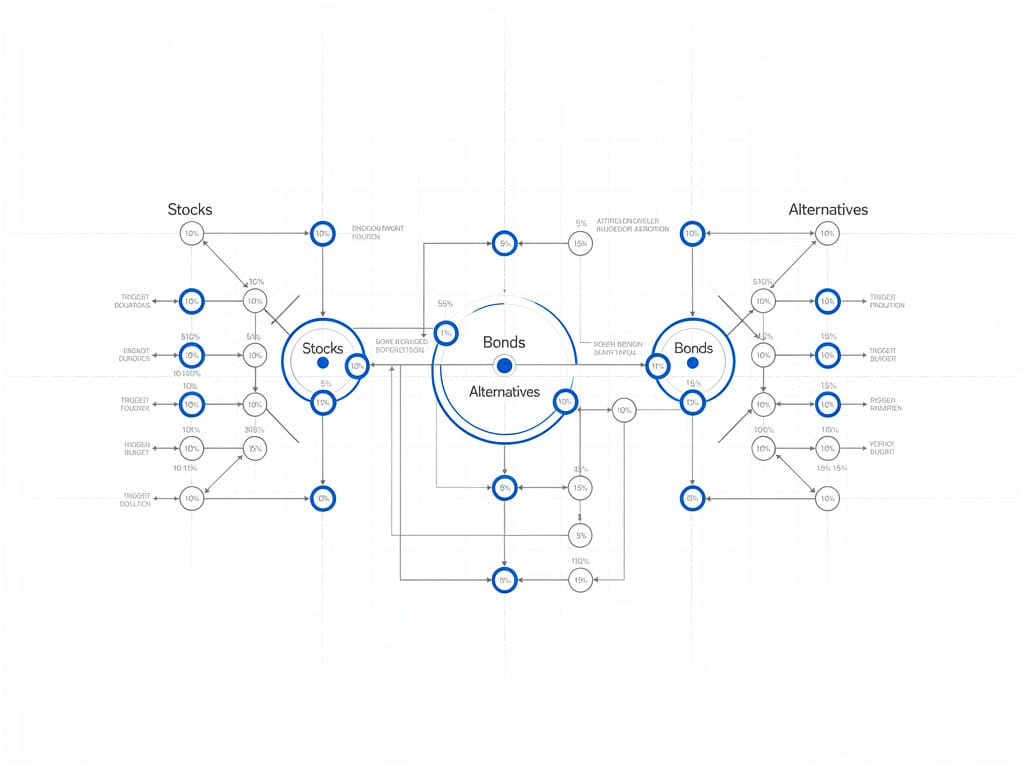
While percentage triggers are a massive leap forward, advanced investors can layer in additional signals to create an even more responsive system. These methods require more attention but can be powerful tools for navigating major market shifts and periods of extreme stress.
- A significant spike in the VIX indicates widespread market panic and often corresponds with sharp asset price drops. This can be a pre-planned signal to assess your portfolio for rebalancing opportunities, as quality assets may be temporarily on sale.
- The rule could be simple: if the VIX closes above a certain level (say, 35) for three consecutive days, you perform an out-of-cycle portfolio review to see if any of your tolerance bands have been breached or are close to being breached.
- This is not market timing. It is using an objective measure of market stress to prompt a disciplined review, allowing you to act logically when others are acting emotionally.
- A sustained shift in central bank policy, such as a definitive move from a zero-interest-rate environment to a period of quantitative tightening, is a prime example. Such a change fundamentally alters the outlook for fixed-income assets.
- In this scenario, you might decide to strategically reduce your allocation to long-duration bonds, even if they haven't breached a tolerance band, because the underlying economic fundamentals that supported them have changed.
- This is the highest level of portfolio management: recognizing when the rules of the game are changing and adjusting your strategy accordingly, ensuring your portfolio is built for the economic reality of tomorrow, not yesterday.
Responding to Major Economic Shifts
Some economic changes are so foundational that they should prompt a strategic review of your entire asset allocation, not just a simple rebalance. These are slow-moving, structural changes, not daily news headlines.
Volatility-Informed Adjustments
Instead of just looking at your own portfolio's drift, you can use broad market indicators, like the VIX (CBOE Volatility Index), as a secondary signal. The VIX is often called the 'fear gauge' for a reason.
By graduating from a simple calendar schedule to a dynamic, trigger-based rebalancing system, you transform from a passive passenger into an active pilot of your financial journey. You are building a framework that protects you from your own emotional biases and forces you to behave like a professional investor-selling high and buying low with robotic consistency. Define your triggers, write them down, and commit to the plan. This is the discipline that builds lasting, sustainable wealth.